


The UK’s Space4Climate showcase demonstrated the value of satellite data for habitat mapping, land-use monitoring, disaster risk prediction and resilience planning.
These capabilities are essential. But they also underline a structural limitation across most Earth observation systems: they detect structures, not operational activity.
Traditional EO tells you where an asset is. It rarely tells you what that asset is doing.
Optical and radar imagery show the outline of a steelworks; they don’t reveal which furnaces are active. They show the footprint of a power station; they don’t quantify thermal output that confirms whether generation is happening, at what capacity, or whether a reported shutdown is real. They monitor land cover but cannot independently verify the activity that drives emissions or risk.
This is the capability COP30 implicitly called out, not just coverage gaps, but capability gaps.
Why thermal intelligence is the missing layer
Thermal infrared data closes that gap because heat is a direct indicator of activity. It cannot be staged, obscured or misrepresented by reporting. It exposes operational reality.
SatVu’s HotSat constellation delivers this capability at 3.5 m resolution, globally, day and night. It provides a uniform, independent view of industrial, energy, and critical-infrastructure activity, even in regions with limited ground access.
Combined with strategic partnerships, including our multi-year alliance with Sanborn Map Company, (one of the US’s most established geospatial solutions providers) we’re able to integrate our advanced thermal infrared data into existing suite of mapping and analytical services to deliver thermal intelligence across the United States.
SatVu’s role is further strengthened by our designation as a Copernicus Contributing Mission, directly aligning thermal intelligence with the priorities underscored at COP30.
By contributing high-resolution thermal data to the Copernicus ecosystem, SatVu strengthens the system’s ability to independently observe real world activity – industrial operations, energy generation, and thermal stress – at the scale required for accountability and action. This integration embeds independent, observable evidence of climate-relevant activity into one of the world’s most trusted climate data infrastructures, supporting transparency, verification, and decision-making across borders.
This means that thermal intelligence is not future potential. It’s operational today.
Evidence: Identifying urban heat vulnerability from orbit
In Darwin, Australia, we partnered with the Office of Planetary Observations to map street-level heat stress and prioritise greening interventions. HotSat data revealed three areas of acute heat exposure where canopy cover was insufficient and surface temperatures presented measurable risk to public health and urban resilience.
This is what independent verification looks like: thermal signatures that identify where climate adaptation resources deliver the greatest impact.

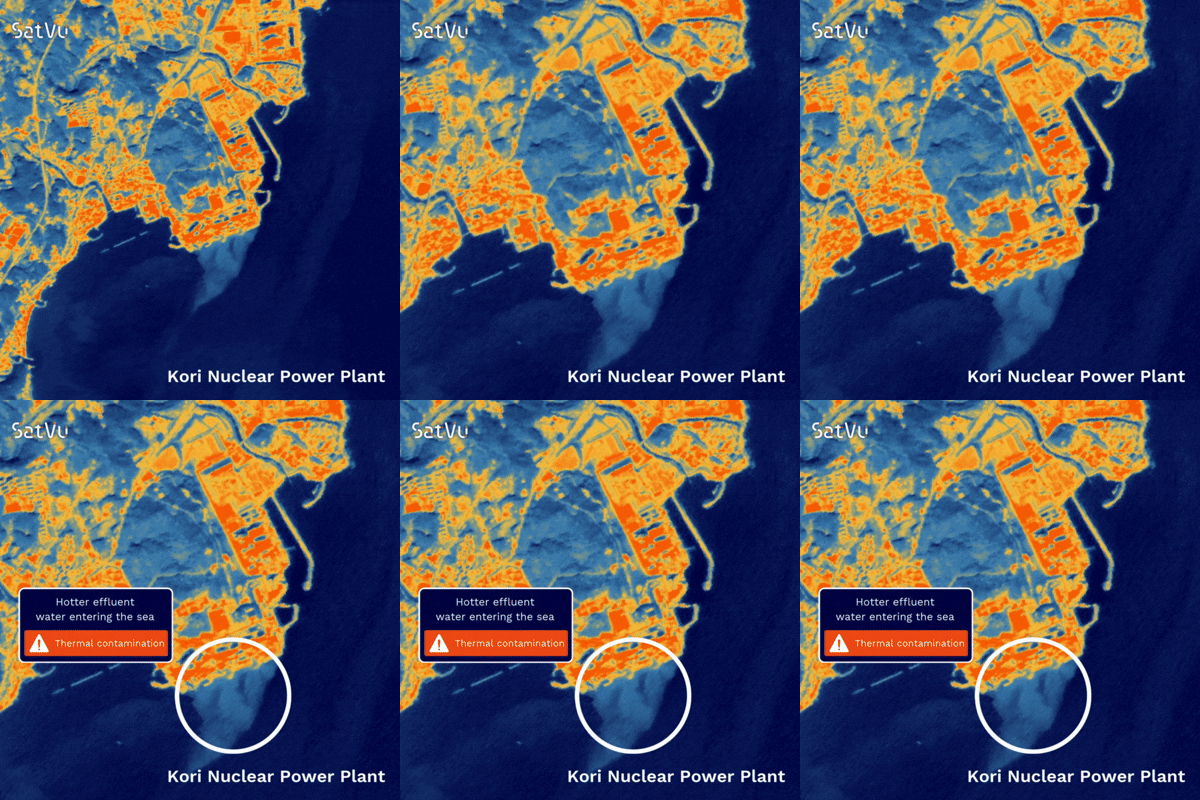
Identifying thermal contamination in South Korea
Thermal data captured by HotSat-1 revealed thermal anomalies associated with water pollution at the Kori Nuclear Power Plant in South Korea. Our high-resolution thermal data made hotter effluent water entering the sea visible, where traditional EO and SAR systems would not.
This is the level of detailed insight that enables stakeholders to proactively preserve water quality and protect ecosystems.
COP30 Made the requirements clear
Across the Planetary Science Pavilion, scientific briefings, and agency statements, three principles emerged:
1. Global accessibility - Observations must deliver consistent coverage, including geographies with minimal monitoring infrastructure.
2. Independent verification - Climate intelligence must be grounded in observable evidence, not self-reported data.
3. Actionable insight - Data must be capable of informing cross-sector decision-making: energy, industry, finance, land-use planning, adaptation.
Thermal intelligence strengthens all three.
It reveals activity where optical and radar remain silent. It enables verification where on-the-ground access is restricted. And it provides operational context - the why and how behind emissions, risk exposure, and economic behaviour.
Closing the coverage gap isn't enough. We must close the capability gap too.
COP30 was clear: observation is now core climate infrastructure.
But without activity-level verification, that infrastructure remains incomplete. The Impact Bond will help expand global networks, but capability must advance alongside coverage.
SatVu is delivering that capability today.
We provide thermal intelligence that distinguishes claims from evidence - transparent, consistent, and globally accessible.
For decisions that require evidence, not assumptions, access SatVu’s thermal intelligence today, contact sales@satellitevu.com to discuss.

